The story
A kid's card game, an AI, and a dad who doesn't code.
Undercard started the way a lot of good games do: a kid and an ordinary deck of cards.
My son invented it, and we played it with real cards: everything dealt face-up in a grid, each card moving its own way, and the move that makes the game, where instead of capturing a card that's too strong, you latch onto it and drag its value down.
At some point I wondered whether it could be a real app, one people could find in the App Store. There was one problem: I don't know how to write code.
Building it without writing code
So I tried something new. I described the game in plain English to an AI, and it wrote the code. A rough first version came from one AI tool; most of the building happened in conversation with Claude, made by Anthropic.
The way it worked was simple. I'd say what I wanted ("the queens should be able to attack from two spaces away", "make the diamond symbol red instead of yellow", "it sounds very computery and blippy"), and the AI would make the change, test it, and show me. I never wrote or edited a line of code myself. My job was to know what the game should feel like and to keep saying "not quite yet".
Rules that changed on evidence
The most surprising part was what happened to the rules. Once the game had computer opponents, the AI could play it against itself, about 200,000 times in all, and tell us how games actually ended. Instead of guessing whether a rule was fair, we could measure it.
Some ideas made the cut, and some didn't:
- KeptThe first move must be a latch. It opens the game up instead of starting with a trade of captures.
- KeptA smaller deck. Taking out the Aces through 4s left 36 cards and a tighter 4 × 9 grid with more action.
- KeptJacks move like chess knights, leaping over the crowd.
- KeptWin by capturing 5 of the 6 Face cards, so a sweep is a real alternative to winning on points.
- DroppedForced Face card captures, where you had to take a Face card whenever you could. We tried it, then took it out.
- DroppedA "swap" rule to cancel out the first player's edge. We tested it and found the edge already small enough.
Who did what
Us
The game itself, every rule, the feel, and every decision about what stayed and what went. Nothing changed without a yes from us.
The AI
All of the code, the computer opponents, the simulations, the animations and sounds, and a lot of options to choose from.
What it became
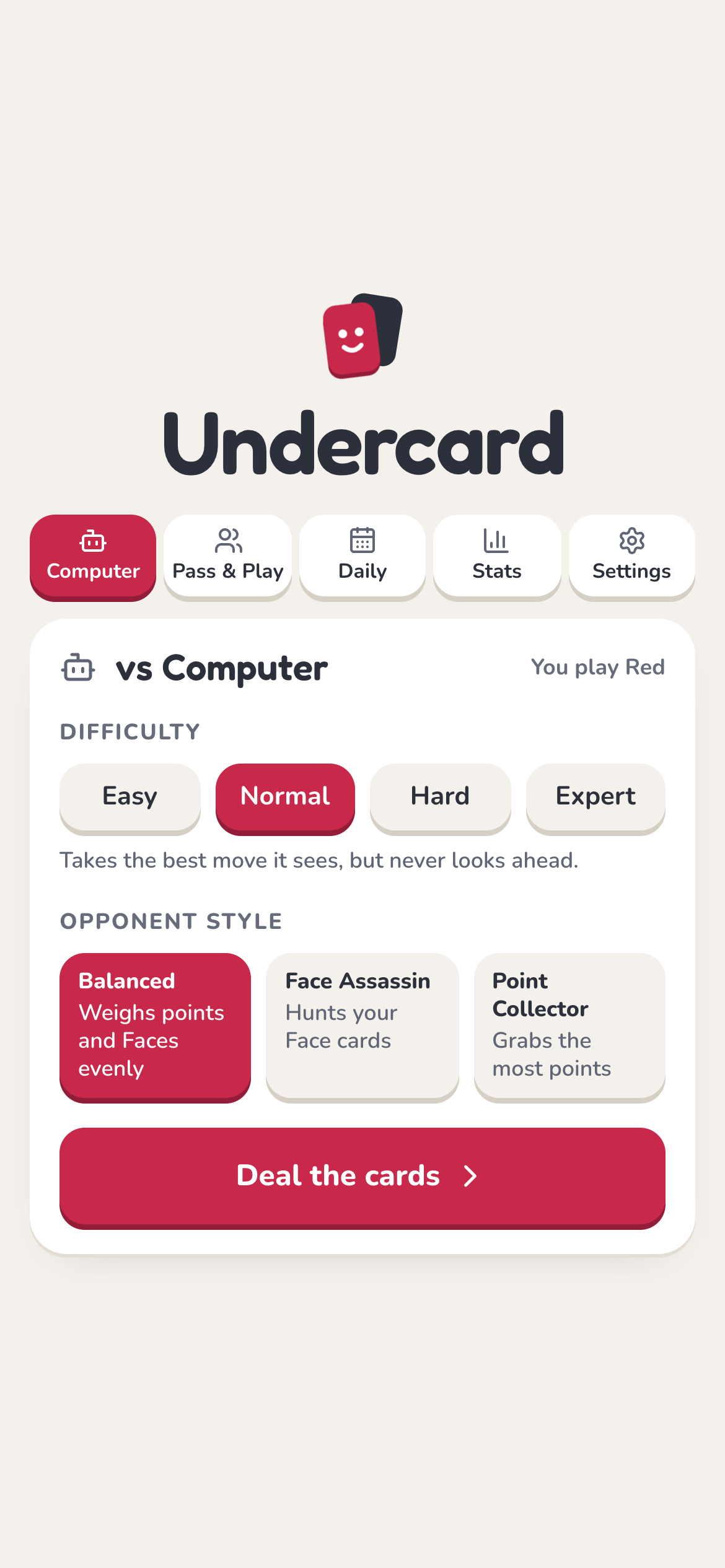
Undercard now has a guided tutorial, four computer opponents from Easy to Expert (Expert thinks several moves ahead), three playing styles, Pass & Play for two people on one device, and a wooden-toy soundtrack of marimba notes. It even changed its name along the way: it began as "Latch", and became Undercard when that name turned out to be taken.
You can play Easy, Normal and Pass & Play free in your browser now. The full game, with Hard, Expert, a daily challenge and stats, is coming to the App Store for iPhone and iPad.